
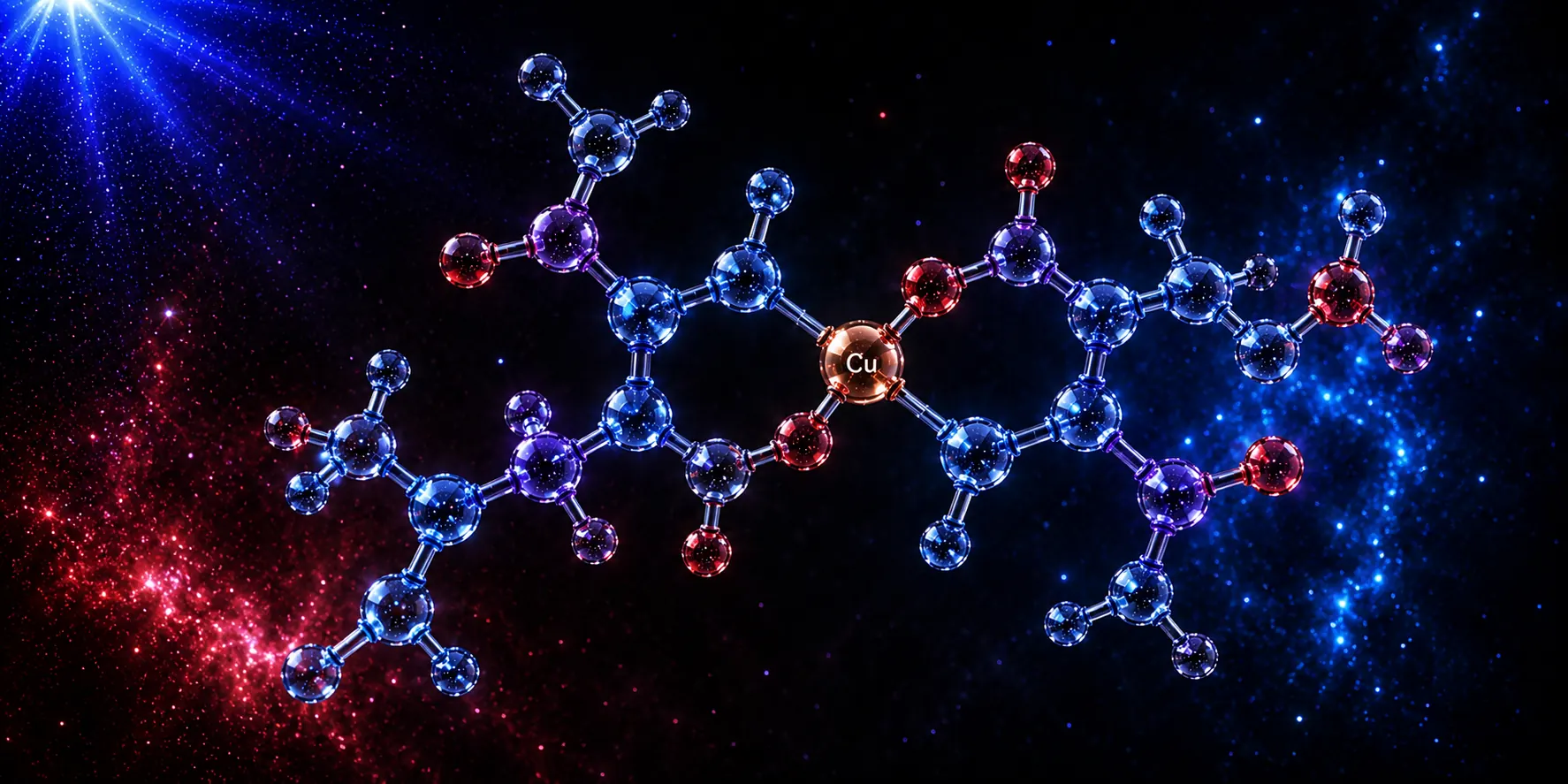
 Illustrative Molecular Illustration
This publication has been prepared by the iRenew Research Institute as an educational scientific resource. It is intended to summarize current experimental understanding of GHK-Cu within the broader context of regenerative biology, extracellular matrix physiology, copper biology, and systems-level biological communication.
The content presented herein is based upon preclinical and laboratory research available at the time of publication. It is not intended as medical advice, clinical guidance, or evidence of therapeutic efficacy. References to biological mechanisms or experimental findings should not be interpreted as recommendations for human or veterinary use.
The Institute encourages readers to approach all emerging scientific literature with methodological rigor, critical evaluation, and an appreciation for the evolving nature of biological research.
GHK-Cu occupies a distinctive position within regenerative biology because it illustrates how a simple endogenous tripeptide, through its affinity for copper, may participate in complex biological networks involving extracellular matrix remodeling, cellular communication, tissue adaptation, and homeostatic regulation.
Rather than representing a single-target biological mechanism, GHK-Cu serves as a model for investigating systems-level coordination among structural proteins, signaling molecules, and trace-element biology.
Accordingly, the iRenew Research Institute classifies GHK-Cu as a Regenerative Biology Reference Peptide.
How do endogenous signaling peptides coordinate with essential trace elements to influence tissue organization, extracellular matrix maintenance, and regenerative communication across multiple physiological systems?
Within this framework, GHK-Cu provides a valuable research model because of its naturally occurring presence, its copper-binding properties, and its extensive investigation across connective tissue biology, extracellular matrix physiology, dermatological research, and gene regulation.
GHK-Cu is unique because it exists naturally within human plasma, saliva, and urine while demonstrating a high affinity for copper ions, linking peptide biology with trace-element physiology. Its scientific importance extends beyond any single experiment, serving as a framework for understanding coordinated regenerative biology and systems-level communication.
GHK-Cu (glycyl-L-histidyl-L-lysine complexed with copper) is an endogenous tripeptide–copper complex that has attracted sustained scientific interest because it links peptide signaling with trace-element biology. Originally identified in human plasma, it has subsequently been investigated in laboratory models involving connective tissue physiology, extracellular matrix remodeling, dermal biology, angiogenesis, antioxidant responses, and patterns of gene regulation.
Unlike compounds studied for a single biochemical target, GHK-Cu is frequently examined as part of an integrated biological network. Experimental findings suggest that its relevance emerges from interactions among extracellular matrix proteins, growth-factor signaling, inflammatory regulation, and tissue homeostasis rather than from one isolated mechanism.
Accordingly, this monograph presents GHK-Cu as a systems biology reference peptide whose educational value lies in understanding coordinated regenerative physiology.
Copper is an essential trace element required for numerous enzymes involved in cellular respiration, antioxidant defense, connective tissue maturation, and extracellular matrix organization. GHK exhibits a high affinity for copper ions, forming the GHK-Cu complex under physiological conditions.
Experimental research has explored how this complex may influence cellular signaling environments associated with collagen turnover, fibroblast activity, extracellular matrix maintenance, and gene expression. Rather than functioning as a conventional receptor agonist, GHK-Cu appears to participate within broader regulatory networks that influence multiple biological processes simultaneously.
Current evidence continues to evolve, and the complete biological mechanism remains an active area of scientific investigation.
Interest in GHK-Cu spans several decades of experimental investigation. Early studies focused on its identification as a naturally occurring peptide capable of binding copper. As research expanded, investigators explored its relationship with tissue remodeling, dermal physiology, wound biology, extracellular matrix organization, and molecular signaling.
More recent systems biology investigations have examined changes in gene expression associated with GHK-Cu exposure in experimental settings, prompting continued discussion regarding its potential role as a model for coordinated biological adaptation.
The Institute therefore presents GHK-Cu not as evidence for any clinical outcome, but as an educational framework for examining how endogenous peptides, trace elements, and extracellular signaling networks interact within regenerative biology.
The scientific literature has explored GHK-Cu across multiple laboratory disciplines, including connective tissue biology, dermal physiology, extracellular matrix remodeling, in vitro wound models, and investigations of age-associated biological change. These studies seek to better understand endogenous signaling rather than establish clinical efficacy.
Current areas of research include:
The breadth of these investigations reflects the interconnected nature of regenerative biology rather than a single mechanistic pathway.
Common Name: GHK-Cu
Chemical Description: Glycyl-L-histidyl-L-lysine copper complex
Classification: Endogenous copper-binding tripeptide
Primary Scientific Disciplines
For laboratory research purposes, GHK-Cu should be handled using established laboratory procedures appropriate for peptide materials. Stability is influenced by formulation, temperature, light exposure, moisture, and storage duration.
Researchers should consult manufacturer documentation, Certificates of Analysis, and applicable laboratory protocols for storage recommendations specific to the material under investigation.
1973 — GHK identified as a naturally occurring human tripeptide.
1970s–1980s — Early investigations characterize copper-binding properties and biological significance.
1990s — Research expands into connective tissue biology and extracellular matrix physiology.
2000s — Experimental interest broadens to dermal biology, wound models, and molecular signaling.
2010s–Present — Systems biology and gene-expression investigations further expand understanding of coordinated regenerative communication.
The scientific literature concerning GHK-Cu spans more than five decades and includes investigations in peptide chemistry, copper metabolism, extracellular matrix biology, dermal physiology, wound models, and systems biology. Readers are encouraged to consult the primary peer-reviewed literature for detailed methodology, experimental limitations, and interpretation of findings.
Representative areas of publication include:
The iRenew Research Institute strongly encourages researchers to obtain a current Certificate of Analysis (COA) for every research material prior to laboratory use. A COA should verify identity, purity, analytical methodology, batch information, and testing performed by qualified analytical laboratories.
Educational publications issued by the Institute do not replace independent analytical verification of research materials.
Scientific understanding of endogenous signaling peptides continues to evolve. Individual experimental findings should be interpreted within the broader body of evidence rather than in isolation. Reproducibility, methodology, and appropriate controls remain essential components of rigorous scientific investigation.
The Institute encourages multidisciplinary interpretation that integrates molecular biology, physiology, biochemistry, and systems biology.
GHK-Cu demonstrates how a naturally occurring tripeptide can serve as a window into the remarkable complexity of biological communication. Its enduring scientific value lies not in a single reported outcome but in its ability to illuminate relationships among copper biology, extracellular matrix organization, tissue maintenance, and coordinated physiological adaptation.
As research advances, GHK-Cu will likely remain an important educational model for understanding how relatively simple endogenous molecules participate within sophisticated regulatory networks.
Founding Edition v1.0
Prepared under Institute Standard No. 006 — Publication Lifecycle Standard.
This manuscript represents the third volume published within the iRenew Research Institute Research Library.
Research Monograph No. 003 — GHK-Cu
The Biology of Copper Peptides, Tissue Remodeling, and Regenerative Signaling
Founding Edition · Version 1.0
Founding Publication
This publication was prepared in accordance with the Editorial Standards of the iRenew Research Institute. Every effort has been made to present current scientific understanding accurately, responsibly, and within the context of available experimental evidence at the time of publication.
The iRenew Research Institute believes that responsible scientific publishing should accomplish more than the distribution of information. It should cultivate understanding — transforming complex scientific literature into educational resources that encourage thoughtful investigation, critical evaluation, and lifelong learning.
Dedicated to the researchers, educators, laboratory professionals, and lifelong students whose curiosity continues advancing scientific understanding.
“Knowledge becomes meaningful only when it leads to understanding.”